
The Best Low Sugar Protein Shakes for Diabetes in Australia
Share
Have you ever stood in the health aisle, turned over a handful of different “diabetic” shakes, and felt puzzled as to why so many are sweetened with sugar or packed with artificial sweeteners, with seemingly nothing in between?
If that’s felt frustrating, you’re not imagining it and you’re not being fussy. Finding a shake that’s genuinely low in sugar, high in protein and easy to drink is harder than it should be.
Let’s walk through what actually makes a shake suitable for diabetes, how to read a label properly and where the real differences lie.
The Quick Answer
When it comes to diabetes, a shake that may generally suit would have a lower total carbohydrate load, less added sugars and enough protein to keep you full and support steadier energy after meals. The catch here is that a lot of products marketed “for diabetes” don’t meet all three, and the only way to know is to turn the tub over and read the back.
Why The Front Of The Label Can Mislead You
It’s easy to be reassured by the word “diabetes” or “low GI” printed on the front, but the front of a pack can be simply marketing. The back is where the truth really sits. Two things are worth checking every time.
The sugar and carbohydrate numbers. Some products that seemingly feel diabetes-friendly can still carry a surprisingly high total carbohydrate load, sometimes from added glucose syrup solids or maltodextrin, which can affect blood sugar levels even when a pack claims to be “low glycaemic index” (GI). It’s also worth reading past the sugar figure to check the full ingredients list. These don’t all behave in the same way, as some ingredients marketed as fibres or syrups, such as malt extract or isomalto-oligosaccharides, may affect blood sugar in ways that aren’t always obvious.
The sweetener list. This can often be the one many people will miss. When a product lowers its sugar, that sweetness often has to come from somewhere, so it’s replaced with artificial sweeteners or sugar alcohols. This means that a lot of people who are managing their diabetes will end up consuming far more artificial sweeteners than they had ever intended to, simply because they were looking at the sugar component and not the ingredients list.
Sweeteners are also easy to miss for another reason: they’re often listed by a food additive number rather than a familiar name, so unless you know the codes themselves, they can slip straight past you. Some common artificial sweeteners to recognise are:
- Acesulphame potassium (950)
- Aspartame (951)
- Cyclamate (952)
- Saccharin (954)
- Sucralose (955)
It’s also worth checking for sugar alcohols (also called polyols), which can likewise be listed by a number rather than a name:
- Sorbitol (420)
- Xylitol (967)
- Erythritol (968)
- Maltitol (965)
While many of these sugar alcohols are naturally occurring, consuming them can have laxative effects such as gas and bloating, particularly in larger amounts.
Now, not every sweetener with a number is artificial. Steviol glycosides, better known as stevia (960), is a natural, plant-derived sweetener, as is monk fruit. The point isn’t that a number is good or bad, it’s that knowing what the codes mean allows you to see exactly what you’re consuming. If you’d rather limit artificial sweeteners or sugar alcohols, the ingredients list will help you get started.
What To Look For
When you turn the pack over, these are the questions worth asking:
- How much total carbohydrate is in a serve, and where does it come from? Watch for added starches and syrups.
- Is there added sugar, and how is the sweetness achieved? Look at whether it’s sugar, artificial sweeteners, sugar alcohols, or naturally sweetened with something like monk fruit or stevia.
- How much protein is in a serve? Protein helps slow digestion, promotes fullness, and supports steadier blood sugar after meals. If you’re not sure how much protein you actually need for your body, our guide to how much protein you need has a simple table to work from.
- Is it gentle to drink? A shake only helps if you can finish it comfortably, without bloating or an aftertaste that puts you off.
For reference, to meet the requirements to be called a formulated meal replacement in Australia, a product must provide at least 12g of protein, plus specific amounts of daily vitamins and minerals, in every serve (Food Standards Australia New Zealand). This is a useful floor, and a genuine meal replacement should meet it comfortably. And whilst there’s no single “right” carbohydrate number to aim for, as this can vary between individuals, Diabetes Australia’s carbohydrate counting typically treats 15g as one carb serve, which is a helpful yardstick when you’re comparing labels. An accredited practising dietitian can help you determine what’s right for you.
A Note On Insulin And The Bigger Picture
It’s often worth remembering that for many people, their type 2 diabetes did not arrive overnight. They’ve often existed on the insulin resistance spectrum for years beforehand. We explore why that early window of opportunity matters, and why a fasting insulin level is often measured later than it might be, in Fasting Insulin: Are We “Weight-ing” Far Too Long, which includes a podcast conversation on the topic. A shake is only ever one small part of a much bigger picture, and your GP, dietitian or healthcare team can help you put the whole thing together.
If You’re Also Taking A GLP-1
Some of our readers who have diabetes and are looking for a shake to support them may also be taking a GLP-1 (glucagon-like peptide-1) medication, and have a noticeably smaller appetite. When your appetite is smaller, the goal quietly shifts. It’s no longer just about protein, it’s about making every mouthful count, with something more nutritionally complete, gentle on the gut, and easy to finish. If that sounds like you, we go into it properly in Finding a Protein Shake That Works With a GLP-1.
One Option That Ticks These Boxes
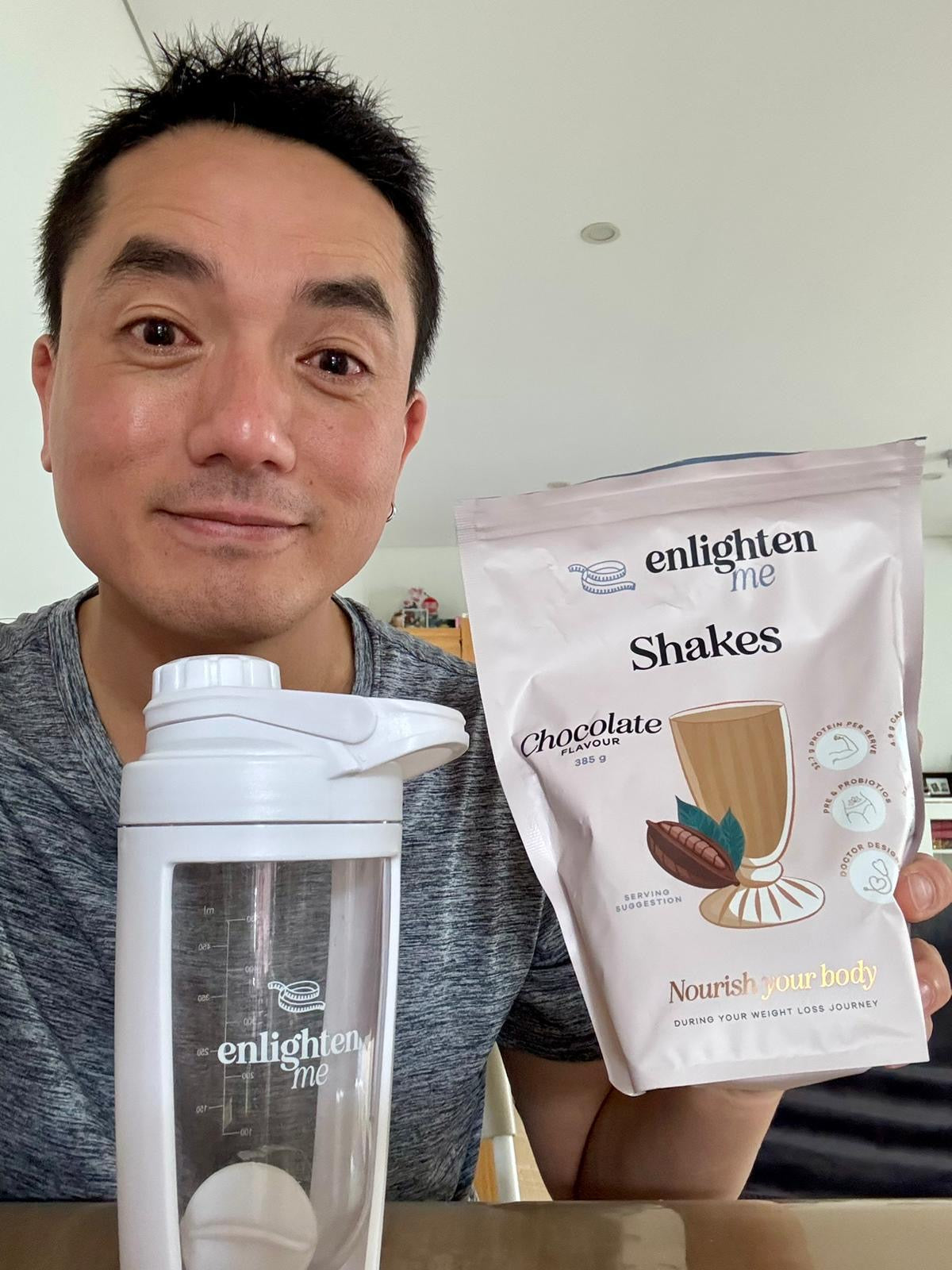
Now, looking at our own Enlighten Me Shakes and holding them to this same level of analysis:
- Naturally sweetened with monk fruit and stevia, not sugar or sugar alcohols.
- Low in carbohydrate, at around 5.5g per serve, with no added sugar, maltodextrin or glucose syrup.
- High in protein, with over 32g per serve, roughly a palm-sized amount, to help you stay full.
- FODMAP friendly and gluten free, so they’re gentle on a sensitive stomach.
If you like the idea of a low-carb treat as well, the same shake works in recipes like our high protein chocolate mousse. Whether a shake like this is right for you depends on your own needs, and your treating team is the best place to check.
A Few Questions We’re Often Asked
Are protein shakes safe for people with diabetes?
For many people, a well-chosen, low-sugar shake can be part of balanced nutrition. What matters is the total carbohydrate, the type of sweetener, and the protein. Because everyone’s situation is different, it’s worth checking with your own doctor or dietitian about what fits your plan.
What should I look for in a low-sugar shake?
Low total carbohydrate, no added sugar, a clear sweetener you’re comfortable with, and enough protein to keep you full. Reading the back panel matters more than any claim on the front.
Can I use a meal replacement shake if I’m on a GLP-1?
A meal replacement can be a helpful way to get balanced nutrition in when your appetite is low, but whether it suits you is a conversation for your own healthcare team. We cover the nutrition side in more detail in our GLP-1 shake article.
Is a naturally sweetened shake better than one with artificial sweeteners?
Neither is “better” for everyone, and different products suit different people. If you’d prefer to avoid artificial sweeteners or sugar alcohols, the thing to do is read the ingredients list rather than trust the sugar figure alone.
A Closing Thought
Managing diabetes shouldn’t mean squinting at the back of every pack in the aisle. But until front labels tell the whole story, reading the ingredients is the single most useful habit you can build. Once you know what you’re looking for, choosing a shake that genuinely suits you gets a lot simpler.
This blog provides general information only. For information that is tailored to your own circumstances, please speak to your own treating practitioner.